Saturday, 12 March 2016

GSDs at Crufts 2016: the continuing travesty


The above clip was all Channel 4 showed of the GSD in the Group judging at Crufts on television tonight. It was the only dog in the Group that wasn't shown moving.

The only explanation, surely, is that the Kennel Club - which claims no editorial control  over the TV footage - vetoed it being shown, embarrassed at the state of the dog.

The bitch, Cruaghaire Catoria, really was a shocker, and very stressed by the occasion. She was nervy in the breed ring earlier in the day, too.

But of course it wasn't just her temperament.

Below is footage of her winning Best of Breed at Crufts today - alongside the just-as-awful Best Dog,  Ch Yupp Vom Hammelsbacher Hof.


The Crufts Facebook page is being bombarded with complaints.


It is just heart-breaking. 

How much longer can we stand by and not insist that something is done about the state of this breed?

See also: 


Good Gordon! Keeping it in the family

Ch Lourdace Fulcrum - winner of the Gundog Group, Crufts 2016

My inbox is full of emails this morning from show peeps who wouldn't normally say my name without spitting venom.

The reason?

The Gordon Setter that won the Gundog group at Crufts last night was bred and is co-owned by the judge's sister.

But really... so what?

Amusingly, there was an item on the TV coverage last night that present the show world as a lovely little community where everyone looks out for each other.

The reality is that it's a nest of vipers and people can't wait to stick the boot in.

But I fail to see the great scandal here. The showing bug often runs in families and it's a small world. Inevitably, loads of people are related to each other or in relationships with each other.

Indeed, you've got to ask what judge Di Arrowsmith was supposed to do - ignore the dog because of the relationship? That would surely be unfair.

James, as Ch Lourdace Fulcrum is known, won Best of Breed under a different, independent judge. He is clearly a lovely-looking dog and my personal tip for Best in Show because he ticks a lot of boxes - beautiful, a vulnerable breed and his handler co-owner came over well on TV last night.

This might just be my wishing thinking, though - or perhaps the fear that I will self-combust if that disgraceful ball of fluff that won the Toy Group waddles off with the top prize.

Of more concern to me is that Ch Lourdace Fulcrum has a hip score of 27. He is the son of a sire with a hip score of 17 and his dam's score was 27; hardly surprising his hips aren't great.

A score of 27 is almost triple the breed average (the 5y rolling median is currently 10).  James has also already sired three litters, two of them to bitches with hip scores also above the breed median (18 and 11).

The BVA advice is to not breed dogs with hip scores above the breed median.

I hope James is used judiciously at stud from here on in.  I've met a lot of older Gordons who look terrible on the move - clearly stiff and sore. It is, I'm afraid,  one of the consequences of a breed that is no longer kept fit and functional by the work it was originally developed to do. (Very few Gordons in the UK are working gundogs).

I have suggested, several times, that dogs should come to the ring with some existing points in the bag - e.g. for good hip scores/health tests/working qualifications/lower than breed-average inbreeding etc. I can't see that it would be anything other than a win-win situation - for the dogs and for Kennel Club PR.

But no. Crufts and other dog shows remain primarily about outside appearance and not inner health.

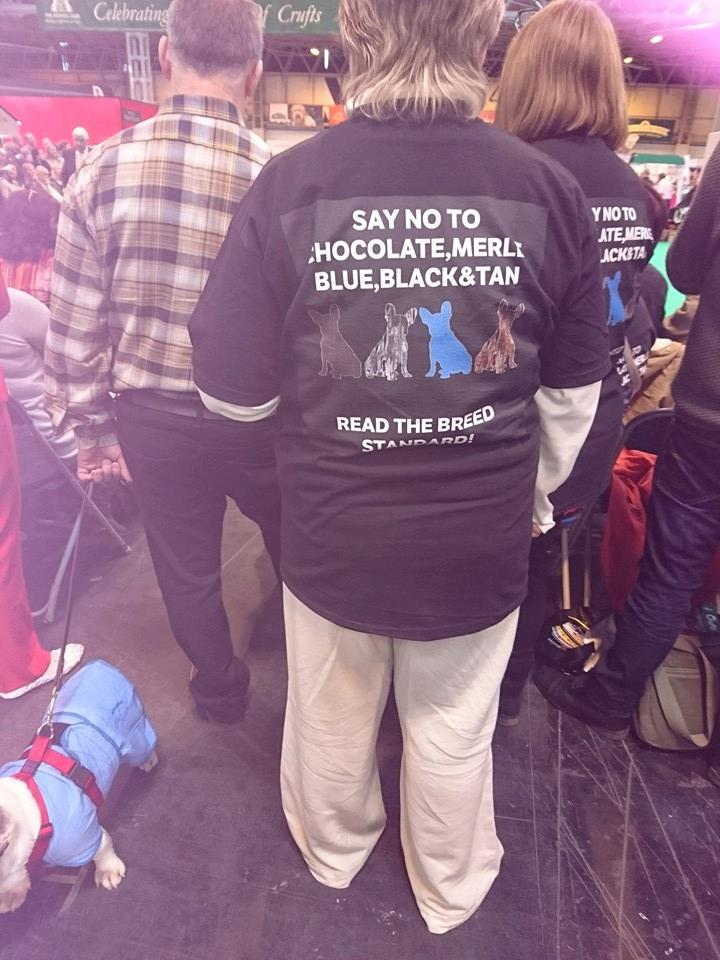
Guess what I saw at Crufts?!


Well, I wish. What the T-shirt actually said was this.


Most show Frenchies have terribly stenosed nostrils. It is a potentially life-threatening fault and yet it's non-standard colours that get the French Bulldog show peeps hyperventilating. They are obsessed with the increasing popularity of French Bulldogs that are the 'wrong' colour - and loathe that non-show breeders take advantage of the recessive colours that lurk in the breed. 

Now there is certainly reason to worry about merle - it's a gene in a double-dose that can certainly cause defects and it was almost certainly introduced into Frenchies from another breed. But chocolate, blue and black and tan? These are just cosmetic issues. The genes are there recessively in the breed. 

(Blue in some breeds can by associated with a condition called colour dilution alopecia, but there's no evidence of it in blue Frenchies.)

Both the UK and FCI standards call for open nostrils - and in fact "totally closed nostrils" is a disqualifying fault in the FCI standard.  And yet this is routinely ignored. This dog, shown at Crufts on Thursday, is absolutely typical of what you see in the ring. No wonder that, according to recent research, 50 per cent of Frenchies have problems breathing.


Yep. You guys do indeed need to read the breed standard.

Friday, 11 March 2016

EXCLUSIVE: Crufts winner Bert Easdon breeds crossbreeds

Isn't it just great when you discover that a top show breeder is willing to embrace genetic diversity?

There was I thinking that the breeder of the winner of the Crufts 2016 Toy Group would be a dyed-in-the-wool purist. But no! Here are just some of the ads placed by Peke breeder Bert Easdon and his partner Philip Martin, of the famous Yakee kennel, on the internet site Pets4Homes in the past two years.


Of course, they breed purebred dogs too. Lots of 'em!


Given that their 70-acre country estate in Dumfriesshire, which they bought for £975,000 in 2002, is rather remote, they even kindly offer to save you the journey to collect your puppy.


How do I know it's them?  Well, helpfully, there's this...Same basket... same blanket.. same stuffed toys. Plus although the contact details have been removed from these ads because the pups have been sold, the name listed when the ads are live is Philip Martin, Bert's partner.

Click to enlarge

Now I'm genuinely pro-crossbreeding when it's done well. I have no inherent objection to people making money out of dogs as long as their dogs are carefully bred and well-raised/kept. Maybe, although they don't mention it, all their stock is fully health-tested. Maybe pimping your puppies in cutesy-pie wicker baskets surrounded by soft toys is just fair-enough marketing these days. And while I am not a fan of breeding kennels, maybe these ones are exemplary and all those dogs get to run about their 70 acres every day.

I hope so.

Last night, the TV coverage of Crufts on More4 had a repellent piece of pro-purebred propaganda which said it was a myth that crossbreeds were healthier and implied there was no reputable crossbreeding - singling out the Cavachon as one designer cross being flogged on the internet by people with no morals for loadsamoney. The item also blamed the rise in the popularity of the designer dog for a 70 per cent increase in imported puppy-farmed pups from eastern Europe. (The reality is that many if not most of those imports are purebred pups - French Bulldogs, Pugs etc)

Here's (some of) the offending footage (NB: may not be available in every country).

Crufts 2016: watery-eyed, exercise-intolerant maggot wins the Toy group


Tonight, the Toy Group at Crufts 2016 was won by a Pekingese, Ch Yakee Ooh Ah Cantona.  I confess I yelled "Nooooo!" so loudly that all my dogs ran out of the room.

But at least they could.  Poor Eric had to be carried in the ring tonight by his rather creepy joint-owner Bert Easdon; and when the poor little thing was made to waddle for the judge, out popped a U-shaped tongue (seriously, can any Peke move at all without panting?) and the dog did his best to take a short-cut.

Afterwards, a tired Eric sat watery-eyed on the sofa with Easdon, who explained that his top show-dogs didn't actually live in the house because if they were allowed to mix when in full show-coat, they would chew each other's ears.

Thus denied even this one act of revenge on the humans who have bred them, Eric and his fellow hostages are doomed to spend their show careers crated or kennelled on their own. I bet they don't get out much, either.

The judge was awful too, making a point of dipping her pasty face into every dog's face, even pursing her lips to kiss one or two of them.  She may love her dogs, but she should know better than to do this with strange dogs - even the supposedly fondle-friendly runway models at Cruft's. The Italian Greyhound , the Crestie and the Pug recoiled visibly.

For those that don't know, Eric is the grandson of Yakee A Dangerous Liaison (aka Danny the Peke) who won Crufts in 2003,  After Danny's win, a rumour spread that Danny had had "a facelift". Owner Easdon denied it, saying that the dog had had an exploratory operation for tonsillitis.

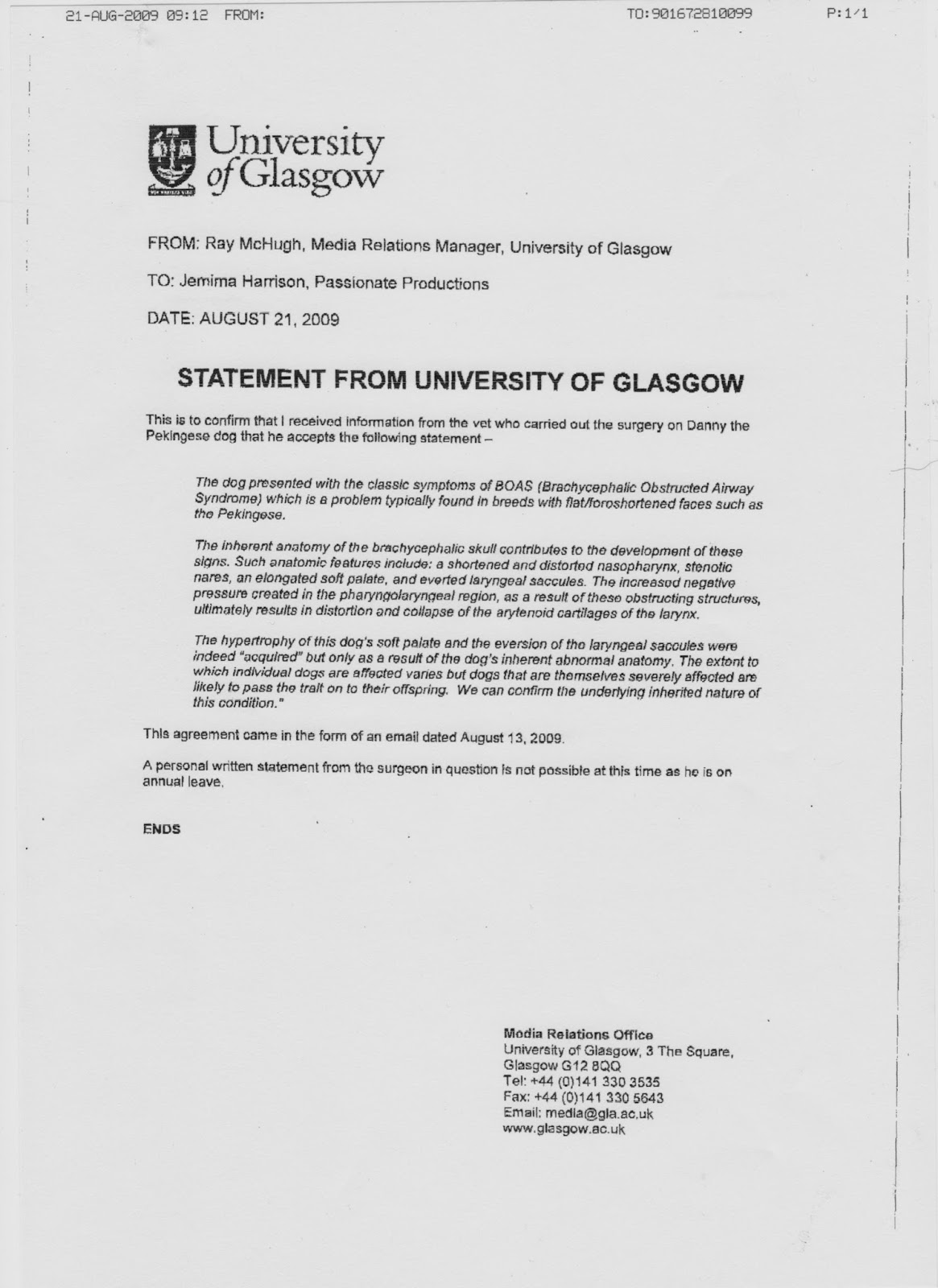
In fact, as we revealed in Pedigree Dogs Exposed, Danny had had surgery to treat BOAS (brachycephalic obstructed airway syndrome) before his big win. I've never published this before, but now seems as good a time as any to show you this statement from Glasgow Vet School.


Despite this, the Kennel Club allowed Danny's win to stand. 

Danny sired over 49 puppies from 19 litters. His grandson Eric has already sired 59 puppies from 22 litters. 

There are no necessary health tests for Pekingese - and none listed for either dog on the KC's database.


Eric celebrated his win by chewing off what remained of his legs

Related post: Crufts winner Bert Easden embraces genetic diversity

Monday, 7 March 2016

RIP Darby


Shocking videos reveal the extent of breathing problems in short-faced breeds


This distressing video is included in a new online initiative by a team at Cambridge Vet School aimed at educating owners, breeders and veterinarians about the breathing problems in short-faced dogs (what's known as brachycephalic obstructed airway syndrome - BOAS for short).

The Bulldog above, for instance, is demonstrating the impact of an elongated and thickened soft palate.

What you can hear with this Pug, below, is laryngeal noise.  As the team explains:  "It is called 'stridor' and it is a high-pitched noise, similar to wheezing and different from low-pitched noises like snoring or snorting. Usually this type of noise indicates a narrowed or collapsed larynx."


It is also often obvious in the way the body heaves when trying to take in air.


Then there's this noise which indicates nasal obstruction - when nostrils are pinched (stenotic) or because the nose is blocked by scrolls of bone and cartilage called nasal turbinates.  This can be accompanied by nasal flaring, where muscles around the nose contract as the dog tries to suck in air - very evident in this short clip.


Here's a mix of both pharyngeal and nasal noise.


And, finally, this is reverse sneezing -  very common in brachycephalic breeds and not as bad as it looks because it rarely last for more than a minute. It's actually something many dogs do, including some of my own (non-brachy) dogs.  I've never seen anything as severe as this, though.


I am sure the Cambridge BOAS research group would like me to point out that these are quite extreme examples. Not every Bulldog, French Bulldog of Pug suffers like this. I should say, too, that it is important for owners to seek help way before their dogs' breathing gets this bad - and to remember that BOAS is progressive. Dogs that are only mildly effected when young can go on to suffer. BOAS experts now advise that surgery early on is more effective than waiting.

The Cambridge team is specifically looking for brachycephalic dogs with no respiratory issues to help with their research.  If you have a Pug, Frenchie of Bulldog with whisper-quiet breathing, find out how you can help here.

It is the first time researchers have put together videos to show how different types of respiratory noise reflect where the problem lies internally.  The problem in the dog that is.

The real problem for Bulldogs, Frenchies and Bulldogs lies in a small part of some people's brains that releases a neurochemical hit in response to seeing a dog with a face like a baby's, even if the poor creature is blue with the effort of trying to suck in air.

Hopefully, we can cauterise it with education.