Saturday, 12 November 2011

Discover Dogs 2011

From the "Stop the BBC Making Another PDE" Facebook site this eve...

The "Stop the BBC Making Another PDE" Facebook site issued several dire warnings in the past week warning good dog folk to be on their guard at this weekend's Discover Dogs against "JH" taking pictures without permisson. Their cunning plan? To take photographs of me or anyone who might conceivably be an agent of mine.

That would, then, be pictures taken without permission. The irony appeared to be somewhat lost on them.

In fact, the Kennel Club had refused us access to film so we couldn't. No ifs or buts -  BBC rules are strict on this and secret filming is only allowed in special circumstances. There was nothing to stop us filming outside, though, so we set up camp outside to ask visitors about their breed choice; then I paid for a ticket to have a quick whizz round the show in the last hour; camera switched off and firmly zipped in the camera bag.

Don't think the KC trusted me to keep it zipped though. As I stopped to have a chat with Sarah Blott from the Animal Health Trust at the Cavalier Matters stand, the KC's Caroline Kisko and Bill Lambert approached and hovered.  Bill then followed me as I wended my way towards the exit, quite literally ducking behind breed stands to try to avoid being seen; at one point peering through a gap in one stand's dressing to keep me in sight. Very Keystone Cops.

I doubled-back and collared him, telling him he should feel free to say hello. I also thanked him for the information he had sent me last week in response to questions about the Assured Breeder Scheme. "I look forward to seeing how negatively you use that information," said Bill.

"Well," I replied, "I am a bit surprised to learn that the KC has inspected only 15 per cent of the breeders who have joined the Assured Breeder Scheme."

I mean, really, and with the best will in the world, it is quite hard to put a positive spin on that, isn't it?

On the plus side, Bill also told me that all breeders who have registered more than two litters in the previous 12 months are now inspected before they are accepted and that there are plans to extend this to all applicants (although he couldn't say when).

But if (as is the case) the KC has only done 1100 odd inspections in total since the scheme started in 2004 and they only have 23 breeder advisors (compared, for instance, to over 100 in Sweden where in 2010 alone they did 2000 breeder visits), when exactly is the KC going to get round the 6,000 or so ABS breeders who have never been inspected?

There was some good news at Discover Dogs during my brief visit.  A breed advisor was honest about the health issues in Boxers on the Boxer breed stand and it was good to see health informaton given real prominence on the Griffon stand, as it was last year. I also saw nothing to stop me lusting after a Hovawart (despite worries about the small gene pool).

But I'm afraid the rep on the Neopolitan Mastiff let the side down when asked if the breed had any health problems. "Not really," came the reply. He also maintained that they lived on average to 8 yrs old (not really his fault - this entirely unsupported claim is in black and white in the health info the Club prepared for Discover Dogs; a bit of a shame because the rest of the health info is not bad).

Finally, despite having lookouts/security in place to protect the Neapolitan Mastiffs from me and prying lenses, this picture was sent to me this evening of the dog on the breed stand this afternoon.


Just to make it crystal clear to Neapolitan Mastiff breeders who will no doubt express outrage: the crime is not in my publishing pictures like this; it's in you breeding dogs like this.

If you don't want pictures of Neopolians with desperate eye conformation, too-narrow nares and sore skin being blogged or broadcast for everyone to wince at... stop breeding them this way.

Edit 13/11/11 @ 20:04

Now that we know this dog is Rayvonley Leone (see comments), here is a picture of him at Darlington Championship Dog Show a few weeks ago, where he won Best Dog. If you click to enlarge it, you'll see there is no skin irritation under his nose, but his chin looks sore and his eye looks no better than it does in the above picture.


Edit 13/11/11 - 

The reaction from the anti-PDE Facebook site....


So now we know. The dogs are just fine. I have, apparently, been photoshopping the images in order to make the dogs look bad.

Which beggars the question: if I could prove that I have not photoshopped them, would they agree that there is a problem that needs to be fixed?

Sunday, 30 October 2011

Neapolitan Mastiff - 1949-2011

I think this YouTube video is intended as a celebration.

But you be the judge.

Saturday, 22 October 2011

"Wrinkled skin, no legs and willies that drag on the floor"

 
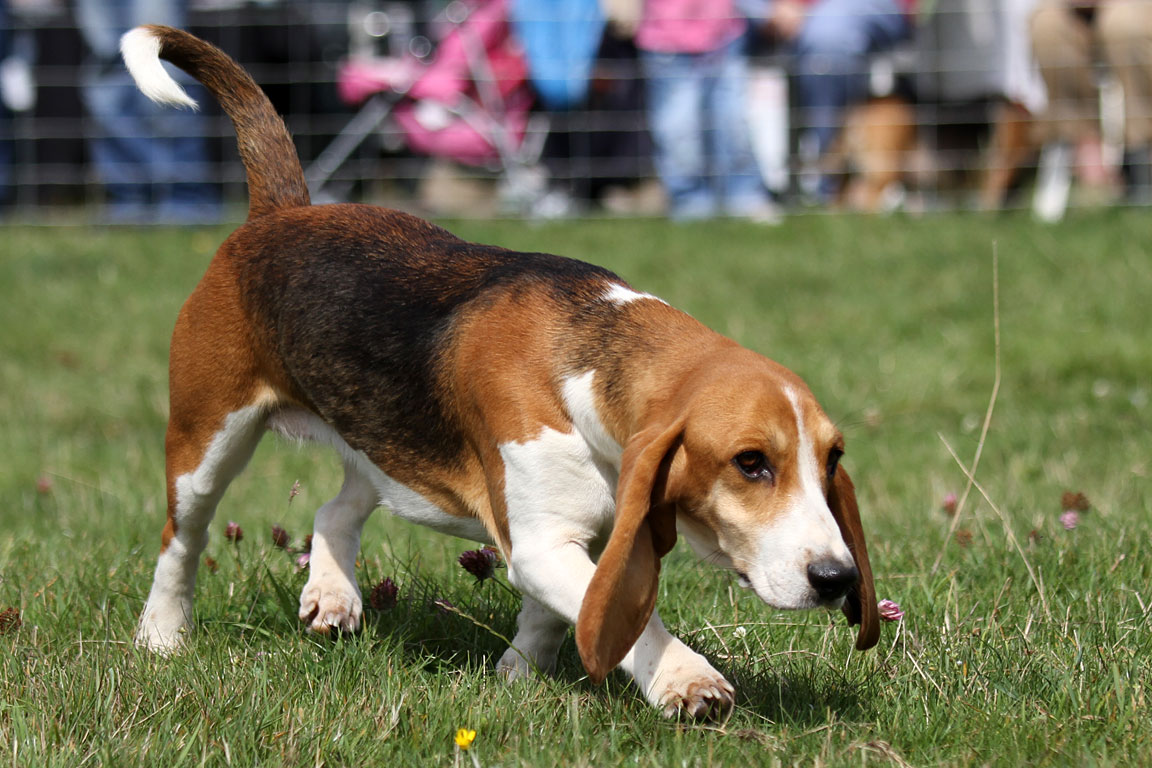
I have a weakness for dogs on which Nature has applied eye-liner. And when it has been genetically tattoed on a dog that does the work it was bred to do... gorgeous!

The dog above is a member of a hunting pack: the Albany and West Lodge Basset Hounds.  Here are some more pictures of them taken at their recent Open Day.


So now let's compare them with a young show-bred Basset that won Best Puppy at a recent championship show.

Surely some mistake?
As you can see, this show dog bears little resemblance to the working-bred dog. The Albany Bassets have longer legs, shorter ears, no loose skin and although not all of them have perfectly-tight eyes, they do not have the obvious ectropion that you can see on this winning puppy.

I should say that burdening these dogs with too much skin draped on distorted skeletons is by no means the sole preserve of the dog fancy; many pet-bred Bassets are dreadful too.

We did this. And we shouldn't have done.
So which is the real Basset. Well definitely not the Albany Hounds according to Dave Darley (Clavidar Bassets), who is Vice Chairman of the Basset Hound Club. This despite the fact that the Albany hounds still fulfil their original function when his don't.  Here's what he said in March this year in response to a post here on Bassets in March:

"There are some good looking dogs in the Albany Pack, but they are not Bassets. We dont "talk darkly" about their cross to Harrier, they are simply a cross breed and should be called "Barrier" or "Harriets". The Harrier itself is also a cross breed and has no KC Breed Standard unlike the Fox Hound that the Harrier is a cross breed of. So the Albany "Bassets" are a crossbreed of a crossbreed. How many more breeds would you like us to introduce into our breed but yet still let us call them Pedigree?? At least the Huntsmen who created the Harrier had the decency of changing its name."

This has not gone down very well with Alison Jeffers, Secretary of the Albany Bassets, whose Summer Newsletter I've finally got round to reading. In it she writes:

"Can you believe everything you can find on the internet? Apparently not! Take Dave Darley as an example. He's the current Vice Chairman of the Basset Hound Club. He has never met Jeremy (Master of the Albany Bassets) or me; he has never seen our hounds and he doesn't have any factual information about our breeding lines.


Yet he's quite hapy to blog away, making crass statements about our hounds in an attempt to 'explain' why Kennel Club show hounds look so different from our hounds.


According to Dave it's all because ours aren't Basset Hounds. They are mongrels! According to Dave and others, we have crossbred with Harriers and Beagles to create Albany Hounds, which he then goes on to describe as 'extremely poor versions of an Artesian hound'.


Like many people in the show world he makes statements that are not based on any truth. He should spend a bit of time looking through out stud book before declaring publicly what our hounds have been crossed with. If he did, he would find no sign of either Harrier or Beagle and I am sure he'll be quite 'shocked' at how much KC blood we still have in our hounds.


So if we can breed Basset Hounds that still look like hounds from the 1950s and are proven to be 'fit for purpose' why can't the Basset Hound Club? There's no logical reson as to why they can't. Within 2 or 3 generations most could be dramatically improved, it's just that many breeders don't think their hounds need to be improved, they like them just the way they are: wrinkled skin, no legs and willies that drag on the floor!"

Over to you, Dave and others in the BHC... Given that the Kennel Club has recently re-instated the old B-register, which allows you to bring in dogs from 'outside', how about going the quick-fix route - for the sake of the dogs - and crossing one of your hounds with an Albany?

Here, by the way, is one of Dave Darley's Bassets - with an Albany Basset for comparison

How the Yanks cocked-up the Cocker


Now this is a dog... (as opposed, that is, to a novelty valance) but it sure as hell ain't a gundog.  And yet this American Cocker - Afterglow Zippor Just Annabelle - just won Best in Show at the Gundog Society of Wales Show.

This breed needs to be re-classified as a Toy breed. Its retention in the Gundog Group does a disservice to those breeds that can and do still do the work for which they were bred. And, frankly, this amount of coat is a welfare issue  - not perhaps directly (as long as it is groomed regularly), but because top show dogs can't possibly get much of an opportunity to be dogs. There's certainly no way they could do a day in the field - it would ruin that all-important coat.

And how on earth do the males pee without soaking their coat?

Here's what the Americans have done to the Cocker...  from sturdy sporting dog to dome-headed,over-coated, increasingly-brachycephalic hairdresser's dog in 120 years.

1892: Ch Obo II - the foundation sire of the American Cocker Spaniel

2011: Casablanca's Thrilling Seduction, Westminster BOB
And here's how they did it...

1882
1887
1911

1921


1937 (if only they'd stopped here...)

1940 (or here...)


1941


1946


1953


1959


1969


1981


1983


1989


1993


2000


2011


Saturday, 15 October 2011

Mark + Jake


The handsome beast on the left is my eight-year-old boy Jake - a GSD x sighthound (we think).  The handsome chap on the right is Mark Evans, former Chief Vet of the RSPCA - parentage fully-known despite what some call him for referring to Crufts in Pedigree Dogs Exposed as "... a parade of mutants... some freakish, garish beauty pageant that has nothing, frankly, to do with health and welfare"

The picture was taken last week when Mark, now presenting the highly-acclaimed Inside Nature's Giants on Channel 4, came down to us in Wiltshire for an update interview for the sequel to Pedigree Dogs Exposed. We wanted to know if he regretted making such a strong and controversial statement in the film, particularly as many in the dog world feel it was unhelpful.

Mark's answer? Surprising... but you'll have to wait for the film to be broadcast to find out why...

Add @ 22:40 - some more pix of Jake given the interest... (not that I really need any excuse...)


Monday, 10 October 2011

Lifespan: the long and the short of it

A comment on a Bulldog blog caught my attention this evening. It claims that the Kennel Club has "updated" the average lifespan on its Bulldog breed info page from six to 10.

I was surprised because the 2004 KC health survey found that the median age of death in Bulldogs (based on a good-sized sample of 180 dogs that had died) was 6 yrs and 3 months - not great. As far as I'm aware, there has been no decent survey done since that supercedes this figure,  so I hot-footed it over to the KC website to see what it says.

 
As you can, it lists Bulldog lifespan as "Under 10 years". Now this is true  - but not terribly helpful for anyone seeking accurate information.

In fact, the KC breed info pages gloss over the longevity issue by listing all breeds' lifespans as either "under 10 years" or "over 10 years".  I guess the truth - that some breeds die, on average, a lot younger than 10 - is just too unpalatable, but it is doing puppy buyers a disservice.

After all, the KC health survey found that the median age of death for the Neapolitan Mastiff is 2.33 years. It would be a bit of a shock, wouldn't it, to lose a dog at that age if you hadn't been pre-warned? Particularly when you've forked out £1000 or more for a Mastino pup.

So here, then, is a list of the Top 21 shortest living breeds according to the KC's own 2004 health survey - and,as you see, the median age of death in some breeds is a real cause for concern.

NB: I have excluded the Bracco Italiano as the survey only included one dog that had died, and the stats for the first six breeds are based on very small sample sizes and should be read with caution. A larger survey for Dogue de Bordeaux (based on 79 dead dogs rather than the KC's five) puts longevity at 5.3. Usually, the bigger the sample size, the better - although not if the survey methodology is flawed.

John Armstrong, in an internet survey of Standard Poodle mortality collected data on nearly 1000 dogs but found that means changed very little after 150-200 dogs.)  

Russian Black Terrier - 1.79
Neapolitan Mastiff - 2.33

Dogue de Bordeaux - 3.83
Kooikerhondje - 3.92
Grand Bleu de Gascoigne - 4.54
Pyrenean Sheepdog - 5.79

Miniature Bull Terrier - 6.08
Shar-pei - 6.29

Bulldog - 6.29
Great Dane - 6.50 

Bloodhound - 6.79
Mastiff - 6.83

Shiba Inu - 7.00
St Bernard - 7.00
Irish Wolfhound - 7.04
Leonburger - 7.08
Finnish Lapphund - 7.33
Bullmastiff - 7.46
Bernese Mountain Dog  - 8.00
Nova Scotia Tolling Retriever - 8.00
Cesky Terrier - 8.42


However, on its breed info pages, the KC lists 11 of these 21 breeds as living for "Over 10 years" - including six that are among the eight very shortest-living breeds, including the Dogue de Bordeaux, Kooikerhundje, Grand Bleu de Gascoigne, Miniature Bull Terrier and the Shar Pei.  (The KC also insists that both the Toller and Cesky live longer than 10 despite its survey findings.)

In fact, there are many other discrepancies on the KC's breed info pages as regards lifespan - with many listed as enjoying 10 years or more when the KC's own health survey found a median age of death under 10. This needs to be rectified - unless of course, there are more recent surveys of sufficient quality that shows a longer lifespan.  I'd be happy to include them here if anyone wants to send me the them.

Here, meanwhile, are the 37 breeds who live at least twice as long as the average Bulldog.

Siberian Husky - 12.58
Welsh Springer Spaniel - 12.58
Collie - 12.67
Dachshund - 12.67
Norwegian Buhund - 12.67
Welsh Terrier - 12.67
Beagle - 12.67
Yorkshire Terrier - 12.67
Staffordshire Bull Terrier - 12.75
Whippet - 12.79
Australian Terrier - 12.80
Manchester Terrier - 12.83
Briard - 12.88
Bichon Frise - 12.92
Hovawart - 12.92
Hungarian Viszla - 12.92
West Highland White Terrier - 13.00
Miniature Pinscher - 13.00
Parson Russell Terrier - 13.00 
Papillon  13.08
Fox Terrier - 13.13
Norwegian Elkhound - 13.17
Bedlington Terrier - 13.38
Norwich Terrier - 13.38
Bearded Collie - 13.50
Italian Greyhound - 13.50
Basenji - 13.54
Miniature Poodle - 13.92
Border Terrier - 14.00
Cairn Terrier - 14.00
Swedish Vallhund - 14.42
Canaan Dog - 14.63
Australian Silky Terrier - 14.25
Lhasa Apso - 14.33
Toy Poodle - 14.63
Irish Terrier - 14.83
Lakeland Terrier - 15.46

And guess what? No mistakes there. The KC lists them all accurately as living for more than 10 years.

Individual breed results from the KC's 2004 health survey are available here.

More breed longevity data can be found on Kelly Cassidy's Canine Longevity website (in need of an update but containing much interesting information).

Saturday, 8 October 2011

The Bark... bites

Breeding Paradox
Can dog-breeding practices be changed?

As a cynical outsider might snobbishly see it, Americans have the attention span of an Irish Setter, the intellectual curiosity of an Afghan Hound, the turf-guarding ferocity of a German Shepherd and the hungry greed of a Labrador Retriever. Count up all the beings besmirched by those insults — the dogs, the Americans and perhaps most of all, the Americans who breed those dogs — and you’d have the makings of an army, and an angry one at that. But consider the possibility that, while grossly stereotyping, it contains some underlying kernels of truth, at least when it comes to human foibles. That might give you a better understanding of why the issue of genetic health problems in purebreds caused by inbreeding has never led to more than ripples on the pond of public consciousness in the U.S.

In 2008, the documentary “Pedigree Dogs Exposed” aired on BBC, showcasing the devastating health problems that have resulted from breeding closely related purebred dogs in the United Kingdom. Along with an accompanying push by animal welfare organizations, it prompted a wave of changes and led to re-examination of the appearance-above-all value system many dog fanciers, breeders and kennel clubs have long held dear.

Meanwhile, in the U.S., hundreds of genetic disorders afflict an estimated five million purebred dogs, resulting in close to $1 billion a year in veterinary expenses and incalculable amounts of pain to dogs and their owners. Here, outside of kennel club and breed club circles, the issue has rated little more than a blip on the dog lover’s radar screen, sometimes rising to the forefront, but rarely staying there.
In an attempt to import the debate to U.S. shores — or, in the view of some suspicious breeders, to fire “the first salvo” in an attack on the purebred dog-breeding industry — the Humane Society of the United States (HSUS) convened “The Purebred Paradox” earlier this year. The April conference featured many of the same players who brought the issue out of the shadows and onto center stage in Great Britain. It wasn’t hugely attended, or hugely reported on. Nonetheless, the two-day conference at Gallaudet University in Washington, D.C., led to some serious and, despite the sensitivities involved, even civil discussions of purebred health issues. From the hazards of limiting and closing gene pools to the folly of turning breeds into caricatures of themselves, with exaggerated features that often make their lives miserable and their births difficult: many of the hard topics were on the table.

“It’s extraordinary that we should have bred animals that the only way they can be born is through C-section,” Sir Patrick Bateson said in the conference’s keynote address. Bateson served as chairman of the independent review of dog-breeding practices in the UK that came about in the wake of “Pedigree Dogs Exposed.”

Bateson, emeritus professor of ethology at Cambridge University and president of the Zoological Society of London, was referring to the “brachycephalic” breeds — English Bulldogs and others with wide heads and shortened snouts, many of whom can’t be born naturally and go through life with breathing problems. In the UK, he said, nine of 10 Boston Terrier births require Cesareans.

In his talk, Bateson suggested the inauguration of a public education campaign and better policing of unscrupulous breeders in America. He took pains to point out — as did several other speakers — that he wasn’t proposing people should no longer breed dogs, only that the industry, and dogs, could benefit from increased regulation.

“We have to realize that human breeders are as different from each other as dogs are from each other,” he noted. “Many breeders care enormously about the science and care about their animals. Some don’t know about the science but do care about the animals. And some neither know nor care. There are all types.”

Read the rest of John's excellent article here.