
You're looking at a CT scan of a Chihuahua featured in a new study from researchers at the Universities of Helsinki and Surrey. The red circles mark where there are holes in the skull exposing the brain underneath and it raises big and urgent questions about the breeding of the world's smallest dog.
A linked paper from the same authors (currently in pre-print) reports that more than 90% of the Chihuahuas they examined have these holes - known as persistent fontanelles - along what are known as the suture lines of the skull. It's a result of the skull not fusing properly.

The holes are likely linked to the miniaturisation of a breed that can weigh as little as 1.5kg and sometimes less; also to the shape of the skull, which has become shorter and more domed over the years, particularly in show-bred dogs.
The consequence is a high disposition to head trauma. One vet recalls a Chi that died when a tennis ball dropped on its head. Devastating for the kid that threw it.
Until recently, an open fontanelle in the middle of the head (called a molera by breeders) was actually a mark of purity in the breed - a neurological jewel in the crown. Breeders denied there was a problem with them.
Today, the breed-standard demand for a molera has been dropped by all forward-thinking kennel clubs - ie not the American or Canadian KCs, both of which still mention a molera as being permitted in their luddite breed standards.
In fact, it's very clear from this statement by the Chihuahua Club of America that a molera should not be considered a handicap:.
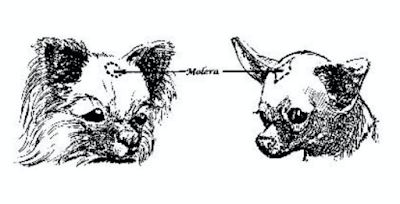
Further, it goes on to maintain: "... the presence of a molera does not mean the Chihuahua has a medical problem."
This is what the researchers set out to find out, prompted in no small part by the knowledge that syringomyelia (fluid-filled cavities in the spinal cord) and other brain abnormalities are found in the breed. Hydrocephalus is also common - although it is true that it does not affect every Chi with a persistent fontanelle and breeders fiercely deny that it is linked.
"Historically, the Chihuahua developed in Mexico and the United States has displayed a “soft spot” on the top of the head. In the Chihuahua this spot, or fontanel, is known as a MOLERA; and is the same as that found in human babies. In the past, this molera was accepted as a mark of purity in the breed, and it is still mentioned in most Chihuahua breed standards the world over. It is important to note that while many Chihuahua puppies are born without the molera, there are probably just as many born with one and its presence is nothing to become alarmed over. As shown in the illustration below, the molera in a Chihuahua will occur on the top of the head and may vary in shape and size when present."

Further, it goes on to maintain: "... the presence of a molera does not mean the Chihuahua has a medical problem."
This is what the researchers set out to find out, prompted in no small part by the knowledge that syringomyelia (fluid-filled cavities in the spinal cord) and other brain abnormalities are found in the breed. Hydrocephalus is also common - although it is true that it does not affect every Chi with a persistent fontanelle and breeders fiercely deny that it is linked.
The UK Kennel Club standard no longer includes any mention of a molera and the FCI standard lists an open fontanelle as a disqualifying fault. Progress.
Indeed, many Chi breeders have recognised that a hole in the head is as undesirable as, well, a hole in the head. In a recent discussion, one UK breeder told me: "The majority of adult Chihuahuas in the UK show ring have no molera at all."
The British Chihuahua Club says: "These days few Chis have permanent molera which persist into adulthood."
But these new papers show that this is not true. The researchers found that even if a central molera is absent, some Chi skulls are littered with these holes, something I imagine is going to come as a shock to most Chi breeders and owners.
Significantly, the scientists found that persistent fontanelles (PFs) are more numerous and larger in smaller Chihuahuas and they also found an association between PFs and syringomyelia, overcrowding at the junction where the brain meets the neck (known as the craniocervical junction - CCJ) and ventriculomegaly (enlargement of the brain's ventricles).
The authors write: "Although their concurrent occurrence does not prove causality, our findings suggest that PFs are associated with the occurrence of these structural abnormalities... Because SM and CCJ overcrowding may cause neuropathic pain and motor deficits, our findings challenge the current conception that PFs are a clinically irrelevant finding not associated with other structural abnormalities."
The suggestion is that the dogs may suffer less if we allowed them to be a little bigger - and in the interests of health, we probably need to moderate their heads, too. We know now that excessive miniaturisation is problematic. We know that brachycephaly and domed skulls are a problem, too (the latter now well documented in Cavaliers as being strongly associated with the endemic syringomyelia in the breed).
Many of today's Chihuahuas have domed heads, short, narrow muzzles which leave limited room for teeth/tongues, and foreheads that fall off a cliff into an abrupt, 90 degree stop. Breeders have selected for a short cranium which overcrowds the brain, pushing the structures upwards into the desired "apple-shaped" head.
The UK Kennel Club standard asks for "an apple-dome skull", sets an upper weight limit of 2.7kg (6lb) and suggests a minimum weight of 4lb (1.8kg).
The AKC disqualifies dogs over 6lb (2.72 kg), with no minimum.
The FCI standard disqualifies dogs weighing less than 1kg (2lb 3oz) or more than 3kg (6lb 10oz).
Interestingly, today's show-bred Chi looks very different from the Chihuahuas of old.
This champ dog from 1949 is admittedly rather weedy-looking but note how the forehead flows into his muzzle from both the top and side. Added bonus: his eyes are well-set into his head.

This European modern Chihuahua (over 40 Bests in Show) is an improvement structurally from the neck down but just look at this head - almost a ball, with a sharp stop and a much shorter, stuck-on muzzle that's beginning to look like an afterthought. Not all of today's show dogs have muzzles this short but it is a trend and there really is no historical rationale for it.

Almost unbelievably, the AKC illustrated standard (NB this is a link to a direct download on dogwellnet.com - the only place I could find it online) features these heads as examples of a correct head. I mean.... the bottom right 😱

Pet-bred Chihuahuas split into two camps - tiny"teacup" Chihuahuas bred by breeders with zero regard for health and bigger/heavier dogs (often up to 10lbs) which tend to have less extreme heads and longer muzzles. When breeders are not actively selecting for small size, nature tries to normalise.
The dogs with more moderate heads/longer muzzles are often referred to as "deer-head" Chihuahuas. It's a term show breeders loathe. ("There's no such thing - it's not a Chihuahua if it doesn't have an apple-shaped head"). These dogs would never win today, but they were the predominant type in the early show-ring.
'There is little doubt the Chihuahua has improved since the breed was first recognized by the AKC in 1904," write two American doyennes of the breed here. 'Chihuahuas shown prior to 1940 were generally of the "deer" or "fawn" type, a bit leggy and longer bodied, and - too frequently, roach backed. Also, well into the 1930's the breed was still showing the results of mixed breeding. The year 1940 brought a marked change for the better, with more breeders recognizing the true Chihuahua type. The strength of the Chihuahua rests entirely in the hands of the dedicated breeders who strive, with each breeding, to produce dogs meeting the breed standard. We think this is a pretty good testimony of the Chihuahua today!'
Nevertheless, "deer-head" Chis are the ones still found in much of Mexico - and they tend to be more popular with pet owners not involved in the pursuit of rosettes. It is also impossible to find anything like the dogs above in the photographic archive.

The closest I can find is this 1903 dog featured in the book "British Dogs" by WD Drury.

I posted this graphic on CRUFFA a few weeks ago to illustrate the difference. NB: I'm reliably informed the Crufts winner posted top left does not have an obvious fontanelle - certainly not one that can be felt by a judge. The skulls beneath are from a dog with the same type of head that did have a molera.

The Chi breeders on CRUFFA objected to me calling the dog on the right a "deer-head", saying the dog still has an apple-shaped head. They did however recognise the dog as a Chihuahua (not always the case when I post more moderate dogs) and although a dog like this would not win in the show-ring today, it gave me some hope that show-breeders could be persuaded to to start selecting for a more moderate head like this one. Aesthetically it is so much more attractive.
The KC's Breed Watch scheme does ask judges to monitor the following in Chis:
Incorrect dentition
Wry jaw
Retained puppy teeth
Misplaced teeth
Protruding tongue as a result of incorrect teeth
Missing teeth
Incorrect bites
Excessively short muzzles
But here's the bitch that won BOB at Crufts in 2019.

This bitch's head makes me wince. There's a significant indent between her eyes (which of course helps give her the desired apple-shaped head) and the muzzle shoots off at less than a 90 degree angle. The tear-staining also suggests a problem with tear-drainage, often seen in Chihuahuas and other brachy breeds and linked to the skull confirmation/shallow eye sockets. Dogs' eyes shouldn't weep.

"Frontal bossing" is a medical term used to describe a prominent forehead and it is often seen in Chihuahuas. In humans - and dogs - it is associated with a number of genetic abnormalities (see here). It is also associated with Hydrocephalus, one consequence of the enlarged brain ventricles documented in Chis in this new study.
But back to the problem of those holes in the skull.
In their upcoming paper, the authors conclude:
"[Persistent fontanelles] are almost ubiquitous in the examined group of Chihuahuas. They are located at dorsal, lateral, and caudal surfaces of the cranium, and hence are not all recognized reliably by palpation in adult dogs. Though the pathogenesis of the PFs described here is unknown, bone-deficient lesions may occur due to congenital defects in cranial bone ossification, delayed closure of cranial sutures, or bone resorption, as is observable in children with craniosynostosis (premature cranial suture closure). Because the imaging findings described in the Chihuahuas of this study are similar to findings among children with craniosynostosis/premature cranial base synchondrosis closure, this growth disorder may be a predisposing factor for the PFs described here."
Research comparing apple v deer-heads in terms of predisposition to persistent fontanelles or neurological issues has not been done. We also have no way of knowing how numerous PFs have been in the breed historically - clearly at least one has been a mark of the breed for a long time.
This skeleton, dating from 1910, shows a Chihuahua skull with several holes in it.

There were no really tiny "teacup" dogs in this study cohort - the smallest dog in the study was 1.4kg (and the largest 4.3kg), and it would be good to look at those too (there's certainly a rationale for thinking that their skulls could be even worse).
It should also be said that persistent fontanelles have been documented in other toy breeds such as Yorkshire terriers (although there are no studies elucidating how common they are). This suggests that they are likely a consequence of miniaturisation.
The authors conclude: "Further studies are necessary to evaluate the pathogenesis and clinical relevance of these lesions."
You bet your bippy and as a matter of urgency - hopefully funded and supported by kennel clubs and breeders. If breed standards, or the interpretation of them, are found to be the cause, major changes in the breed must follow.
You bet your bippy and as a matter of urgency - hopefully funded and supported by kennel clubs and breeders. If breed standards, or the interpretation of them, are found to be the cause, major changes in the breed must follow.
References


